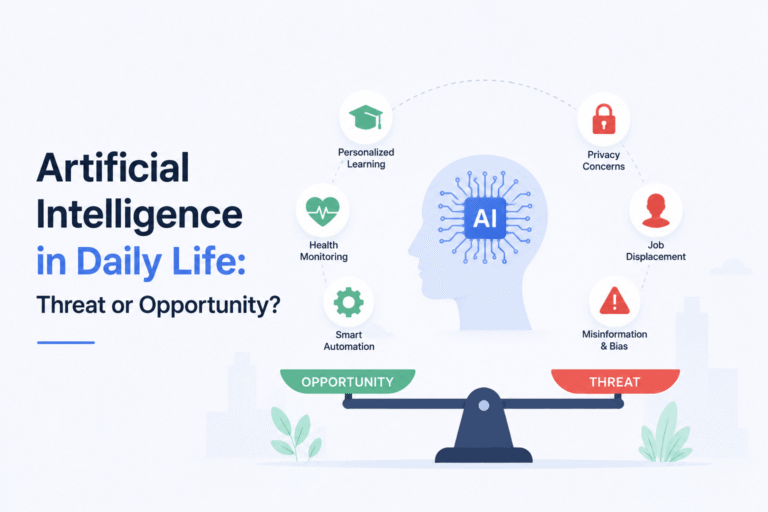
Artificial Intelligence in Daily Life: Threat or Opportunity?

Look around you: AI is no longer a futuristic concept straight out of a science fiction movie. It has quietly woven itself into the fabric of our daily routines. From the moment we unlock our smartphones with facial recognition to the personalized recommendations we see on Netflix, Spotify, or YouTube, Artificial Intelligence (AI) is constantly working behind the scenes.

Yet, as AI technology advances at an unprecedented pace, a fundamental debate has taken center stage: Is AI a threat to our society, or is it the greatest opportunity of our time?

How AI Has Already Become Part of Our Daily Routine

Whether we explicitly realize it or not, most of us interact with AI multiple times a day. Here are a few common examples:

  • Smart Devices & Assistants: Virtual assistants like Siri, Google Assistant, and Alexa help us manage schedules, set alarms, and control smart home devices.
  • Content & Social Media: Algorithms analyze our viewing habits to curate tailored newsfeeds, video recommendations, and targeted advertisements.
  • Smart Content Creation & Productivity: Generative AI tools assist millions of students, writers, and designers daily—helping them draft emails, write code, optimize workflows, and generate visual concepts in seconds.
  • Navigation & Commuting: Apps like Google Maps use real-time data and predictive AI algorithms to suggest the fastest routes and avoid traffic congestion.

The Threat: Why Are People Worried?

The rapid rise of AI has naturally sparked anxiety across various industries and communities. The main concerns usually revolve around three key areas:

1. Job Displacement

The biggest fear is automation replacing human labor. From customer support agents and copywriters to entry-level coders and graphic designers, many professionals worry that AI tools could render their skills obsolete.

2. Privacy and Data Security

AI systems require vast amounts of data to learn and operate effectively. This raises significant concerns regarding user privacy, data harvesting, and how personal information is stored and utilized by tech corporations.

3. Misinformation and Ethics

With the rise of deepfakes and advanced text-generation models, creating convincing fake news, imagery, and audio has become easier than ever. Misuse of this technology poses a serious threat to digital trust and security.

The Opportunity: Why the Future Looks Bright

While the concerns are legitimate, history shows that every major technological revolution—from the steam engine to the internet—initially caused disruption before creating far greater value. AI brings extraordinary opportunities to elevate human potential:

+-----------------------------------------------------------------------+
|                       THE DUAL NATURE OF AI                           |
+------------------------------------+----------------------------------+
|              THREATS               |          OPPORTUNITIES           |
+------------------------------------+----------------------------------+
| • Job displacement in routine roles| • Massive boost in productivity  |
| • Privacy and data security risks  | • Enhanced creative workflows    |
| • Spread of deepfakes & fake news  | • Automation of tedious tasks    |
+------------------------------------+----------------------------------+

1. Unprecedented Productivity

AI isn’t necessarily here to replace humans; it’s here to automate repetitive, mundane tasks. By handling routine data entry, basic research, or administrative work, AI frees up human time for creative problem-solving, strategic thinking, and innovation.

2. Advancements in Healthcare and Science

AI algorithms are analyzing medical images with high accuracy, assisting in early disease detection, and accelerating the discovery of new life-saving drugs—achieving in weeks what used to take years.

3. Personalized Learning and Accessibility

Educational platforms use AI to adapt to individual learning speeds, offering customized guidance to students worldwide and bridging educational gaps across regions.

Threat or Opportunity? The Verdict

So, is AI a threat or an opportunity? The short answer is: it depends on how we choose to adapt.

AI itself is merely a tool—a powerful multiplier of human intent. It lacks human intuition, empathy, emotional intelligence, and genuine strategic vision. The future does not belong to AI alone, nor does it belong to humans who ignore technology.

Bottom Line: AI will not replace humans. However, humans who know how to effectively leverage AI will inevitably outperform those who do not.

Instead of fearing the rise of AI, the best strategy is to embrace it as a personal assistant. Learn how to use prompt engineering, integrate automation into your daily work, and focus on developing uniquely human skills—like creative strategy, critical thinking, and emotional connection—that no algorithm can truly replicate.