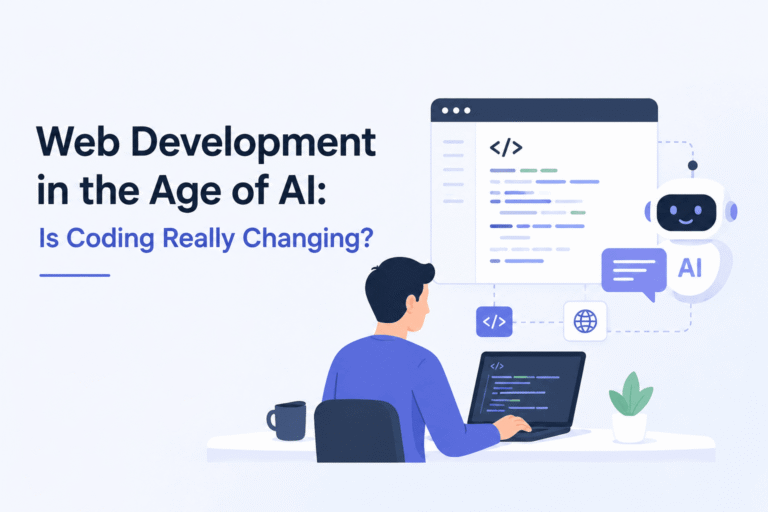
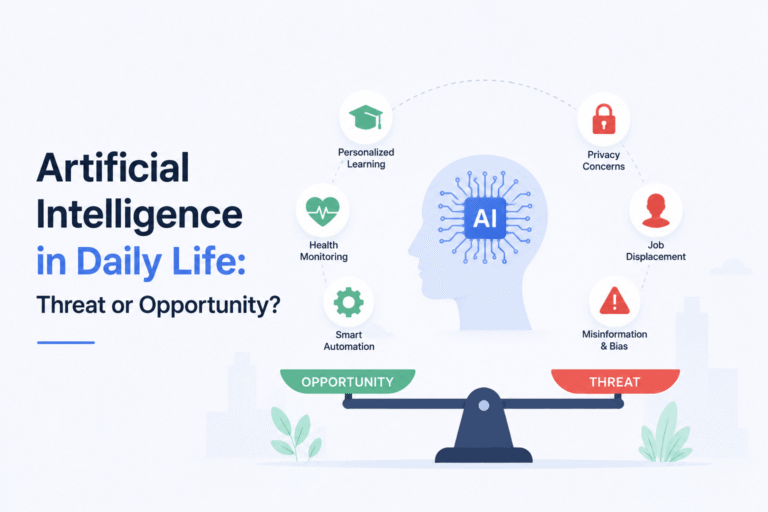
Web Development in the Age of AI: Is Coding Really Changing?
For decades, web development has followed a familiar formula: learn syntax, write HTML/CSS and JavaScript, construct logic, debug line by line, and deploy. However, the explosive rise of generative AI and intelligent code assistants has sparked a massive debate across the tech industry: Is coding as we know it coming to an end, or is it simply evolving into something far more powerful?
As artificial intelligence moves from basic autocomplete features to writing full-stack code, building user interfaces, and fixing bugs autonomously, web developers face a newly transformed landscape.
Here is a look at how AI is actively reshaping web development and what it really means for developers today and in the future.
1. How AI is Transforming the Development Workflow
AI is no longer just a theoretical concept in software engineering; it is an active pair programmer sitting right next to millions of developers.
- Instant Code Generation: Modern AI assistants (like GitHub Copilot, ChatGPT, and Claude) can draft complex functional components, database schemas, and API endpoints from simple natural language prompts.
- Automated Debugging and Refactoring: Instead of spending hours hunting down syntax errors or memory leaks, developers can feed error logs into AI tools to receive instant diagnostics and clean, refactored code.
- UI-to-Code Conversion: Emerging visual AI tools can take a design prototype—or even a hand-drawn sketch—and automatically generate responsive frontend code using modern frameworks like React, Vue, or Tailwind CSS.
2. Is Coding Dying, or Is the Entry Barrier Shifting?
With AI writing clean code in seconds, a common fear has emerged: Will human coders become obsolete?
The short answer is no, but the nature of the job is undergoing a fundamental shift.
+-----------------------------------------------------------------------+
| THE SHIFT IN WEB DEVELOPMENT |
+------------------------------------+----------------------------------+
| TRADITIONAL DEVELOPMENT | AI-EMPOWERED ERA |
+------------------------------------+----------------------------------+
| • Writing syntax line-by-line | • Guiding and directing AI tools |
| • Manual bug hunting & syntax logs | • System architecture & security |
| • Memorizing framework boilerplate | • High-level design & UX logic |
+------------------------------------+----------------------------------+
Writing syntax is only a fraction of what a real software engineer does. AI can generate code snippets rapidly, but it lacks context, architectural judgment, and human intuition.
AI often produces code that looks correct but contains hidden edge cases, security vulnerabilities, or performance bottlenecks. Therefore, the role of a web developer is transitioning from a “code writer” to an “architect and reviewer.”
3. The Essential Skills for the Next Generation of Developers
To thrive in the AI-driven era of web development, developers need to pivot their skill sets toward high-level problem solving rather than simple syntax memorization:
1. System Architecture & Core Engineering
Understanding how databases scale, how microservices communicate, how state management works, and how to structure secure, scalable systems is more critical than ever. AI can write a function, but a human must design the overall ecosystem.
2. Prompt Engineering and AI Orchestration
Knowing how to phrase technical requirements, feed correct context, and guide AI models to produce optimal code is fast becoming a core developer competency.
3. Code Auditing & Cybersecurity
Because AI models are trained on massive public datasets, they can inadvertently introduce outdated practices or security flaws. Developers must be capable of reading, auditing, and hardening AI-generated code before pushing it to production.
4. User Experience (UX) and Business Logic
AI doesn’t understand your end user’s emotional experience or your company’s nuanced business goals. Translating complex business needs into intuitive, seamless user journeys remains a uniquely human skill.
4. The Rise of the “One-Person Tech Team”
Perhaps the most exciting outcome of AI in web development is the dramatic boost in individual productivity.
In the past, launching a full-scale web application required a specialized team: frontend engineers, backend developers, database administrators, and QA testers. Today, an ambitious full-stack developer equipped with AI tools can build, test, and deploy a complete web application in a fraction of the time.
AI acts as a force multiplier—allowing small teams and indie hackers to build product experiences that previously required entire engineering departments.
Conclusion: Adaptability Is the Ultimate Tech Skill
Is coding really changing? Absolutely. But change has always been the single defining constant of web development. We moved from raw HTML to jQuery, from jQuery to modern JavaScript frameworks, and now from manual coding to AI-assisted development.
AI is not replacing web developers; it is replacing traditional, slow development workflows. The developers who embrace these intelligent tools to automate mundane syntax and focus on high-level design, security, and user experience will not only survive—they will lead the industry forward.